Booking software
- Workflow automation and custom tools
- Web design and development
Replace the spreadsheet that runs your business with a proper tool: bookings, quotes, orders, stock or leads, automated and visible in one place.
Short answer
When a business outgrows its spreadsheets, we build the tool that replaces them: a booking system, a quote calculator, an order or stock tracker, a lead pipeline, or a dashboard showing the numbers you make decisions on. Work that used to be copied by hand between email, Excel and messaging apps is automated, and the data ends up in one place.
Last reviewed
Almost every small business has a spreadsheet that quietly runs it. Bookings, quotes, orders, stock, job schedules, leads from the website. It started as a simple list and grew a tab for every new need, colour codes only one person understands, and formulas that nobody dares to touch.
That spreadsheet is not a failure. It is a working prototype of the system the business needs, written by the people who know the process best. Our job is to turn it into the real thing.
We start by watching the process as it runs today, including the workarounds, because that is where the real requirements are. Then a small first version goes into use within a few weeks, on real work, so problems surface while they are still cheap to fix. Your existing data is imported, the old spreadsheet is retired only when the new tool has proved itself, and your team gets training and documentation.
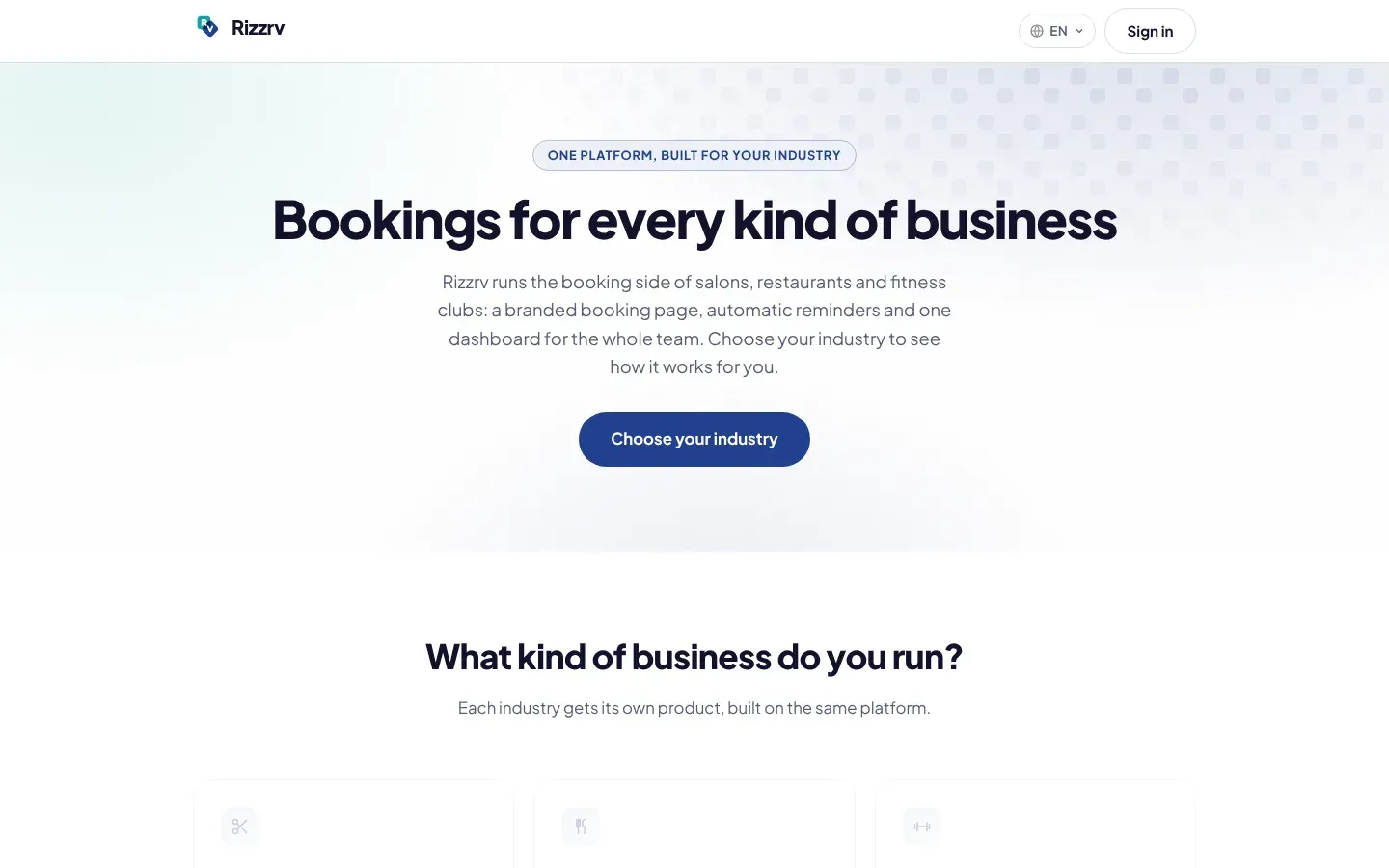
Rizzrv, the booking platform in our portfolio, is this kind of work at product scale: booking pages, reminders, a team dashboard and Google reservations for salons, restaurants and gyms. Most projects are much smaller than that, and that is usually the right size.
Booking software
When more than one person edits the same file, when the same data is typed into two places, when mistakes are only found by customers, or when nobody can answer a simple question such as how many quotes became orders last month without an afternoon of work. Any one of those means the spreadsheet has become a system, without the safeguards of one.
Buy it if a good product fits how you work, and most of the time one does. Build when the process is what makes your business different, when you would need three products glued together, or when per-user pricing gets expensive. Often the answer is in between: an off-the-shelf tool with automations connecting it to everything else.
You do: the code, the data and the accounts it runs on. Nothing is locked to us. If you later bring in someone else to extend it, they get documentation written for exactly that.
Usually very little: hosting and a few services for a small business tool. The proposal includes an estimate of the running cost before the build starts, and it is part of the decision.
Tell us about your business. You get a free, no-obligation proposal from whoever would do the work, with an honest view of what to fix first.
Working with small businesses in Portugal since 2019.